




Belgium Town Park
 |
9th Street, north of Dean Street |
 |
Virtual Tour: click here |
Open Dawn to Dusk
Fast Facts
Park Type: Neighborhood Park
Acreage: 2.8
Park/Facility Code: BTP
Restrooms: Porta-Potty
Trails: 0.19 miles
Activities
- Pickleball – Open Play/Free Use*
*Available on a first come, first served basis. Park District programs and rentals have priority for use. This amenity is not to be used for organized team practice or play.
Amenities
- Court – Pickleball
- Parking – Lot
- Picnic Tables
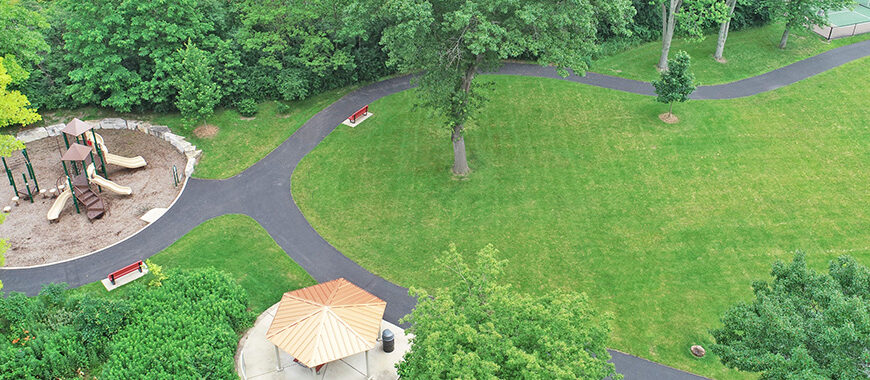
- Playground
- Sculpture
- Seating – Bench (Metal)
- Trails – Paved
- Trails – Unpaved
- Trails – Walking Loop
History
Acquired: 2009
It all began in the late 1890s when the vibrant Belgian-American community first flourished and still remains in St. Charles. A great variety of cultures and nationalities compose St. Charles’ population, but the influence of the Belgian culture has been particularly significant.
Strangely enough, the first Belgians did not come directly from Belgium to St. Charles; they actually made their initial stop in Moline, Illinois which was booming with factories, mills and foundries that were springing up across the Midwest. It was when the Moline Malleable Iron Company burned to the ground and a new foundry was established in St. Charles that the Belgian workers followed the work to their new homes.
The success of the Moline Malleable Iron Company led to the first large housing development in St. Charles – around the Dean Street area. Many of the Belgian immigrants who lived in these homes contributed to the beauty of the neighborhood with their traditional neat lawns and flower beds.
The Belgian settlers also brought their traditional games to St. Charles including Rolle Bolle and pigeon flying. According to Dick Triest, former owner of Ray’s Evergreen Tavern, Rolle Bolle is a game from the old country where players roll a ball resembling a small wheel toward a stake, similar to bowling. The object is to get the ball as close to the stake as possible. Tournaments are still played today among Belgians and non-Belgians alike.
Another popular sport brought from Belgium was pigeon flying. Players would drive west of town and let the birds go. Precise clocks, developed in Europe, were placed on the pigeons to time exactly how long it took the birds to fly back home. Triest claims pigeon racing was a great way to pass the time and has been popular in St. Charles for more than fifty years.
These new citizens also played a significant role on the culture of St. Charles. For instance, in 1916 a semi-pro football team was organized by a group of young Belgian molders employed by the Moline Company. They worked together during the week and played football together on Sunday afternoons. In 1917, the team merged with another team from St. Charles and defeated teams from Aurora, Moline, Rockford, Chicago and the Great Lakes Naval Base. The combination proved successful as the team went undefeated that season, making St. Charles well-known for its semi-pro football.
Eventually the Moline Malleable Iron Company fell on hard times, a victim of decreasing demand and lower cost competition, as well as ever increasing environmental standards. After nearly 100 years in St. Charles, the foundry filed for bankruptcy on April 26, 1991, and the property sat silently undisturbed for a decade.
In 2009, the City of St. Charles rezoned the vacant property in support of the Park District’s plan for development of a neighborhood park. Thus, the District purchased this 2.75-acre parcel that has been an undisturbed part of a manufacturing area at a cost of $400,000.